



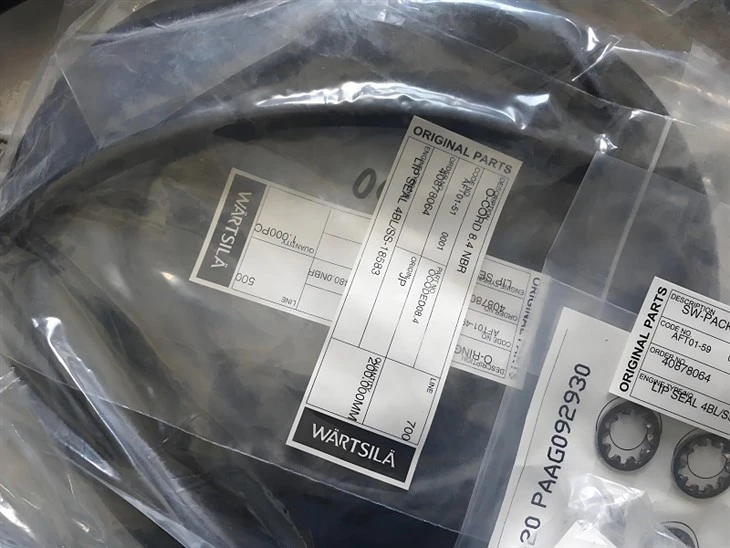


Product Introduction
Stern Tube Sealing Rings are sealing elements installed in the stern tube system of a ship to achieve a sealed isolation between the ship's interior and the external waters when the propulsion shaft passes through the hull.
Product Details
|
Name |
Stern tube sealing rings |
|
Category |
Stern tube |
|
Brand |
Wartsila japan/skf/eagle |
|
Specification |
All specifications are available |
|
Material |
Standard material |
|
Place Of Original |
Genuine/high quality reliable part |
|
Packing |
Standard packing |
|
Condition |
Brand new |
|
Terms Of Delivery |
Exw |
|
Price |
To be negotiated |
|
Ports |
China ports and other ports in the world |
Main Offered Models
MEET ALL MODELS
Main Supplied Range
Stern tube sealing rings, p-ring, sheet packing, forward seal rings, after seal rings, stern tube after bearing, stern tube forward bearing
Advantages
Multi-pass sealing design
Stern Tube Sealing Rings adopt three to five independent sealing structures, with buffer oil chambers between each seal, and the pressure difference range is controlled at 0.3-1.2bar, which can adapt to the changes in bearing loads under different drafts and ship speeds, ensure the physical isolation of oil and water, and meet the standard requirements of classification societies for environmental leakage not exceeding 5ml/h.
High-performance elastic materials
The main seal material fluororubber (FKM) has a long-term service temperature range of -25°C to +200°C, and can withstand instantaneous temperature resistance of +250°C. FKM is chemically inert to synthetic lubricants and biodegradable environmentally friendly lubricants, and maintains a compression permanent deformation rate of less than 15% under high humidity and high salt conditions.
Modular structure
The tail tube sealing ring design is compatible with slit installation and hot splicing processes, allowing seals to be replaced in dry dock or without disassembly, and maintenance time is controlled within 6 hours. Its modular structure can be seamlessly connected with existing bearing and seal chamber structures, supports dual oil chamber pressure balance adjustment and joint control of external oil injection system, and reduces eccentric wear caused by installation errors.
Delivery And Shipping Service

24*7 hours online, our services cover all main ports in the world, we can provide the cost and time saving logistics solution to our customers, to provide you with one stop comprehensive services.
FAQ
Q: What is Stern Tube Sealing Ring and what is its main function?
A: Stern Tube Sealing Ring is a sealing component installed at the end of the stern tube of a ship. Its main function is to prevent cooling water, oil or seawater from entering the cabin from the shaft tube, and to prevent cabin liquid from leaking out of the shaft tube. It is a key component to ensure the normal operation of the stern tube system, anti-corrosion and lubrication.
Q: What factors should be considered in material selection?
A: The sealing ring often uses high-temperature, high-wear and high-corrosion resistant materials such as tungsten carbide, ceramic coating, high-performance polymer or stainless steel composite structure. It should be combined with working parameters such as shaft speed, water pressure, seawater pH, etc. to ensure that the material can work stably in friction, salt spray and impact.
Q: What forms and sizes of sealing rings need to be matched?
A: Suppliers usually provide standard/customized sealing rings with various shaft diameters (200–600mm), water pressure levels and shaft speed ranges. When purchasing, it is necessary to clarify the shaft tube diameter, shaft speed, medium type, operating temperature and pressure to avoid loose sealing or premature wear.
Q: What are the key points of installation and maintenance?
A: Correct installation requires the shaft centering to be carried out according to the supporting instructions and to prevent yaw. After installation, a pressure test should be carried out and water leakage should be checked. Wear, lubricant color change and temperature rise should be observed on a daily basis. If abnormalities are found, they should be replaced in time.
Q: What are the common faults and preventive measures?
A: Typical faults include water leakage caused by damage to the sealing lip, misalignment of the sealing surface caused by shaft wear, cracks caused by material fatigue, and reduced life due to contamination of the sealing medium. Prevention methods include: keeping the shaft tube aligned, regularly replacing sealing elements, keeping lubrication clean, and using an alarm system to monitor temperature and pressure changes.