

Hey there! As a supplier of Marine Pump Impellers, I've been getting a lot of questions lately about what these things actually do. So, I thought I'd take a few minutes to break it down for you in plain English.
Let's start with the basics. A marine pump impeller is a crucial component in any marine pumping system. It's like the heart of the pump, responsible for moving fluids from one place to another. Whether it's seawater for cooling engines, bilge water to keep the boat dry, or fuel for the engines, the impeller plays a vital role in making sure everything runs smoothly.
So, how does it work? Well, it's actually pretty simple. The impeller is a rotating disk with curved blades attached to it. When the pump is turned on, the impeller starts spinning at high speed. As it spins, the blades create a centrifugal force that pushes the fluid towards the outer edge of the impeller. This force causes the fluid to gain velocity and pressure, which in turn allows it to be pumped out of the pump and into the desired location.
One of the main functions of a marine pump impeller is to increase the pressure of the fluid. This is important because it allows the fluid to be transported over long distances and through pipes of different sizes. Without the impeller, the fluid would simply flow back into the pump or not move at all.
Another important function of the impeller is to create a flow of fluid. By spinning at high speed, the impeller creates a suction effect at the center of the pump. This suction draws the fluid into the pump and then pushes it out through the outlet. This continuous flow of fluid is essential for the proper operation of the marine pumping system.
In addition to increasing pressure and creating flow, the impeller also helps to prevent cavitation. Cavitation is a phenomenon that occurs when the pressure of the fluid drops below its vapor pressure, causing bubbles to form. These bubbles can collapse violently, causing damage to the pump and reducing its efficiency. The impeller helps to prevent cavitation by maintaining a high enough pressure in the fluid to keep the bubbles from forming.
Now, let's talk about the different types of marine pump impellers. There are several types of impellers available, each designed for a specific application. The most common types of impellers include open impellers, semi-open impellers, and closed impellers.
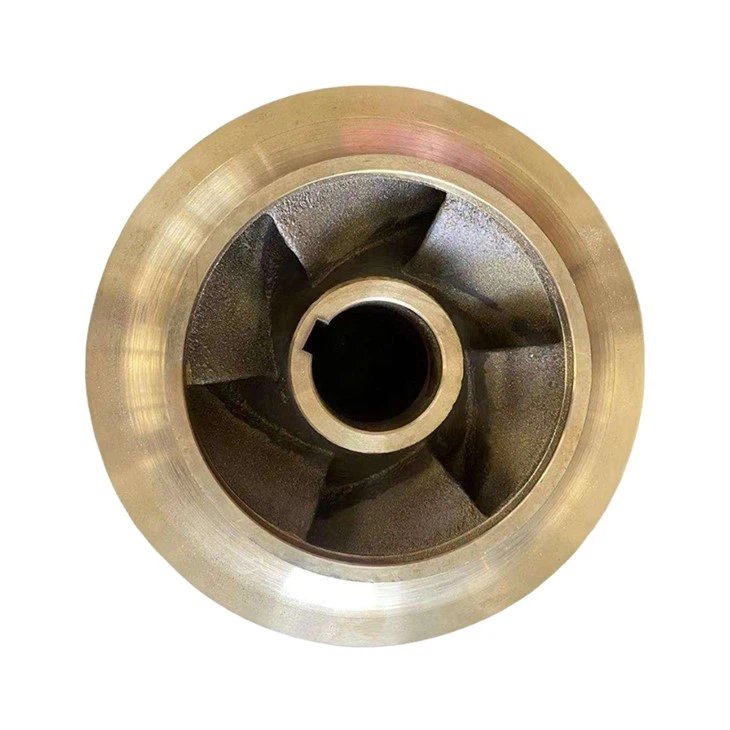

Open impellers are the simplest type of impeller. They consist of a series of blades attached to a hub without any shroud or cover. Open impellers are typically used in applications where the fluid contains a lot of solids or debris, such as in bilge pumps.
Semi-open impellers are similar to open impellers, but they have a partial shroud or cover on one side of the blades. This helps to improve the efficiency of the impeller by reducing the amount of fluid that leaks back into the pump. Semi-open impellers are commonly used in applications where the fluid is relatively clean, such as in cooling water pumps.
Closed impellers are the most efficient type of impeller. They consist of a series of blades enclosed in a shroud or cover on both sides. This design helps to prevent fluid from leaking back into the pump and improves the overall efficiency of the impeller. Closed impellers are typically used in applications where high pressure and efficiency are required, such as in fuel pumps.
As a Marine Pump Impeller supplier, I understand the importance of providing high-quality impellers that are designed to meet the specific needs of our customers. That's why we offer a wide range of impellers in different sizes, materials, and designs. Whether you need an open impeller for a bilge pump or a closed impeller for a fuel pump, we've got you covered.
In addition to impellers, we also offer other marine pump components, such as Marine Pump Mechanical Seal and Marine Pump Shaft. These components are essential for the proper operation of the marine pumping system and can help to extend the life of your pump.
If you're in the market for a marine pump impeller or other marine pump components, I encourage you to contact us to learn more about our products and services. Our team of experts is always available to answer your questions and help you find the right solution for your needs.
In conclusion, the marine pump impeller is a crucial component in any marine pumping system. It plays a vital role in increasing pressure, creating flow, and preventing cavitation. By understanding the function of the impeller and choosing the right type for your application, you can ensure the proper operation of your marine pumping system and extend the life of your pump.
References:
- Basic Principles of Centrifugal Pumps, Engineering ToolBox
- Marine Pump Handbook, various industry publications